

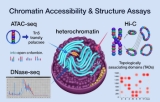
Chromatin accessibility and structure assays profile the openness, nucleosome positioning, and higher-order organization of chromatin to reveal regulatory elements, DNA–protein interactions, and structural features that govern gene regulation. These assays measure where DNA is accessible to enzymes or transposases, how nucleosomes are arranged, and how chromatin compaction varies across cell types, physiological states, or experimental conditions. Typical workflows generate sequencing-ready libraries directly from nuclei or permeabilized cells and are compatible with bulk, low-input, and single-cell formats.
Key Advantages
- Direct Readout of Regulatory Potential: Identifies promoters, enhancers, insulators, and other cis-regulatory elements based on chromatin accessibility.
- Nucleosome-Resolution Information: Fragment-size distributions and periodicity provide insights into nucleosome positioning and occupancy.
- Low-Input and Single-Cell Compatibility: Enables profiling of limited biological material and characterization of cellular heterogeneity.
- Broad Sample Compatibility: Applicable to cultured cells, primary tissues, frozen samples, and sorted cell populations.
- Complementary Multi-Omic Integration: Combines effectively with CUT&Tag, ChIP-seq, RNA-seq, and related approaches to provide comprehensive regulatory insights.
Applications
- ATAC-seq and related tagmentation-based assays for genome-wide open chromatin profiling.
- Nucleosome positioning and chromatin occupancy studies.
- Differential chromatin accessibility analysis across developmental stages, treatments, and disease conditions.
- Single-cell ATAC-seq and multiomic workflows integrating chromatin accessibility with transcriptomic or proteomic measurements.
- Investigation of chromatin compaction, higher-order genome organization, and long-range chromatin interactions when combined with complementary structural genomics methods.
